Table of Content
MiniTool reseller program is aimed at businesses or individual that want to directly sell MiniTool products to their customers. Photo Repair Repair corrupted images of different formats in one go. %NEWFILE%This variable is automatically set to the first parameter given to the CONFIG.SYS directive NEWFILE. %LANGSPEC% (supported since MS-DOS 7.0)This variable is supported by some tools to switch the locale for messages in multilingual issues. %LANG% (supported since MS-DOS 7.0)This variable is supported by some tools to switch the locale for messages in multilingual issues. $LIBPATH or $SHLIB_PATHAlternatives to $LD_LIBRARY_PATH typically used on older Unix versions.

On Windows 10, environment variables are predefined names representing the path to certain locations within the operating system, such as a drive or a particular file or folder. The Environment Variables window is divided into two sections. The sections display user-specific and system-wide environment variables. To add a variable, click the New… button under the appropriate section. %SHORT_YEAR%This pseudo-variable returns the year of the current date in a 2-digit format with leading zeros, f.e.
Setting the path and variables in Windows 2000 and Windows XP
In programming code generally, this helps to distinguish environment variables from other kinds of names in the code. On Unix-like operating systems, environment variable names are case sensitive, but they are not on DOS, OS/2, and Windows. In general, the collection of environment variables function as an associative array where both the keys and values are strings.

The path is now managed by Windows 2000 and Windows XP and not the autoexec.bat or autoexec.nt files, as was done with earlier versions of Windows. To change the system environment variables, follow the steps below. You'll need to close and re-open any command windows that were open before you made these changes, as there's no way to reload environment variables from an active command prompt. If the changes don't take effect after reopening the command window, restart Windows. %MONTH%This pseudo-variable returns the months of the current date in a 2-digit format with leading zeros, f.e. %DAY%This pseudo-variable returns the days of the current date in a 2-digit format with leading zeros, f.e.
User Comments :
If you can’t find Advanced System Settings there, type “advanced system settings” into the search box and hit return to bring it up. Setting environment variables is very useful and, fortunately, very simple. In this article, we’ll go over how to find and set your environment variables in Windows 10.

Information like the location of temporary files from an account, location of your user profile, etc., are stored under user variables. Windows gives the user account the privilege to edit the user variables, but other user accounts cannot edit them. Windows creates and uses several environment variables, some of which are user-dependent and others remain the same for all users on a single machine. We can categorize environment variables using user dependence as a parameter and term them as system environment variables and user environment variables.
Methods to Setup System Environment Variables in Windows
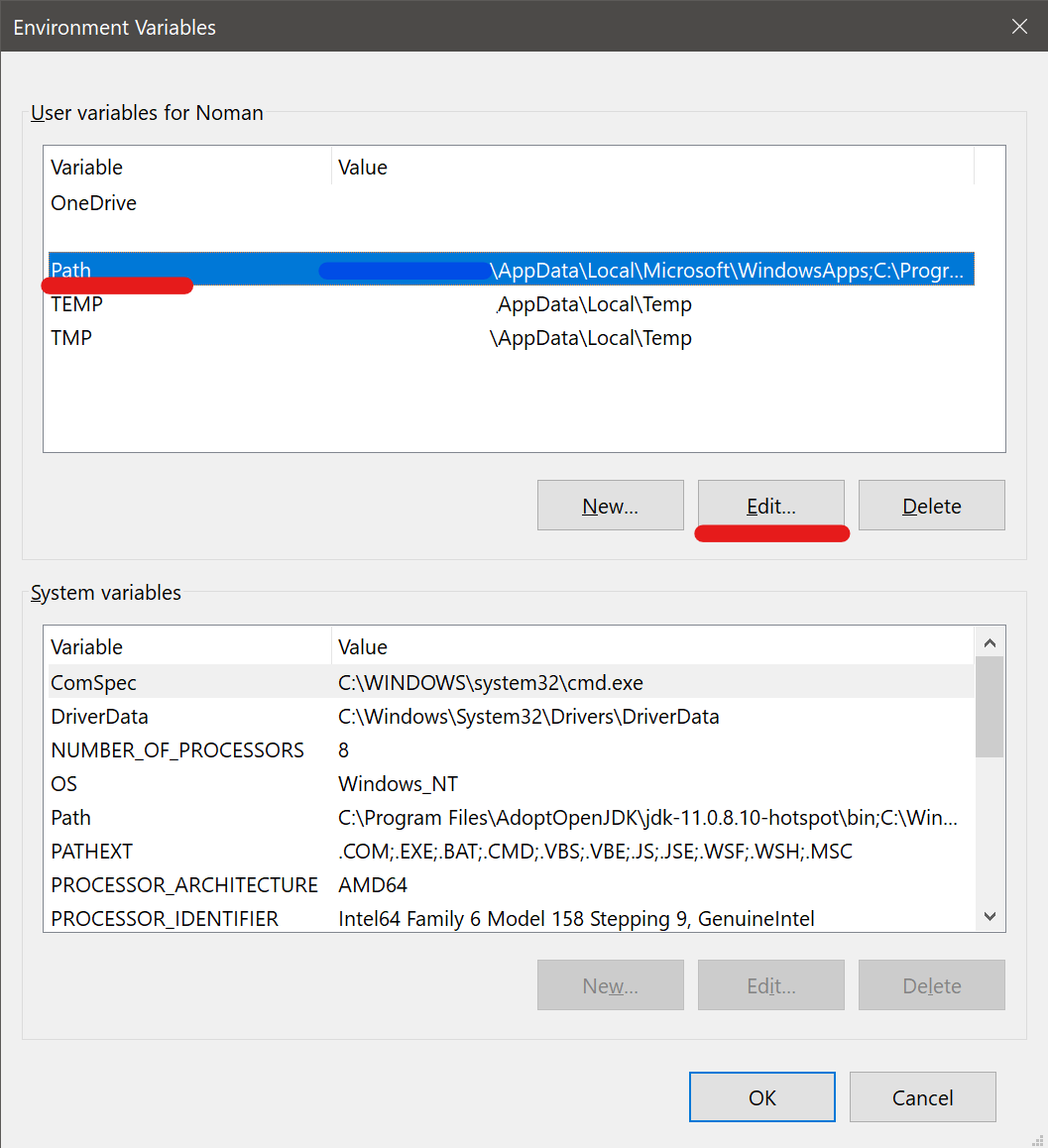
I had missed to mention %systemdrive% environment variable which is equivalent of %homedrive% mentioned by Alex. Please do give me your feedback on this if you find anything incorrect. Click on the “Advanced” tab and select “Environment Variables.” Windows 10 will now display the entire list of user and system variables stored on your computer. There are other environment variables in the System Variables section that you can examine by clicking Edit.
See also the related pseudo-variable %ERRORLEVEL% under DR-DOS and the IF ERRORLEVEL command. %AM_PM%This pseudo-variable returns the ante- or post-midday status of the current time. The returned string depends on the locale-specific version of DR-DOS, f.e. %DIRCMD% (supported since MS-DOS 5.0 and PC DOS 5.0, also supported by ROM-DOS)Allows a user to specify customized default parameters for the DIR command, including file specifications.
DOS, OS/2 and Windows
Both the Command Prompt and PowerShell use the echo command to list specific environment variables. This name is considered obsolete, so Emacs will display a warning if it is used. After creating or modifying the environment variables, restart the computer for those changes to take effect in Windows. In the Environment Variables window , highlight the Path variable in the System variables section and click the Edit button.
This is used to control in a portable way the formatting of the screen output of commands like DIR /W or TYPE filename. See also the related environment variables %$LENGTH% and %DIRSIZE% as well as the similar pseudo-variable %_COLUMNS%. %$LENGTH%Used by DOS Plus to define the screen length of the console in lines. See also the related environment variables %$WIDTH% and %DIRSIZE% as well as the similar pseudo-variable %_ROWS%.
Some DOS software actually expects the names to be stored in uppercase and the length of the list not to exceed 121 characters, therefore the variable is best not modified via the SET command. On Unix, a setuid program is given an environment chosen by its caller, but it runs with different authority from its caller. The dynamic linker will usually load code from locations specified by the environment variables $LD_LIBRARY_PATH and $LD_PRELOAD and run it with the process's authority. If a setuid program did this, it would be insecure, because its caller could get it to run arbitrary code and hence misuse its authority. For this reason, libc unsets these environment variables at startup in a setuid process. Setuid programs usually unset unknown environment variables and check others or set them to reasonable values.
Excel Repair Repair corrupt Excel files and recover all the data with 100% integrity. Unix-like shells have similar dynamically generated variables, bash's $RANDOM being a well-known example. However, since these shells have a concept of local variables, they are described as special local variables instead. Indirectly, they are also supported under Windows' COMMAND.COM, which has been modified to internally call CMD.EXE to execute the commands. %LOCALAPPDATA%This variable is the temporary files of Applications.
PowerShell gives you more flexibility with the environment variables and lets you view, edit, and create them, but these are only valid for a single PowerShell session. The variable list returns to its original form once you close a PowerShell session. Windows 10 supports a number of legacy features from older versions of the operating system. One of those legacy features is the environment variable. Environment variables offer a useful way to control the way Windows operates with an extremely small footprint in terms of memory usage. Run the setx command again to propagate the environment variables and confirm the changes to the registry.
You can use %homedrive%%homepath% environment variable to accomplish this. You just created a new user variable using Command Prompt. Use the “set” command to see the list of all the variables. Here also, you can verify the changed value on the environment variable list.
Shell scripts and batch files use environment variables to communicate data and preferences to child processes. They can also be used to store temporary values for reference later in a shell script. However, in Unix, non-exported variables are preferred for this as they don't leak outside the process. Other than this, Windows contains system environment variables created by the operating system, programs, drivers, and more. You cannot tweak the system environment variables, but Windows offers the option to tweak user environment variables’ values.
When a child process is created, it inherits all the environment variables and their values from the parent process. This procedure gives the calling program control over the environment of the called program. You can see the entire list of environment variables without any categorization, unlike the GUI-based method.




No comments:
Post a Comment